(I'm the one next to the old guy)

Wednesday, March 13, 2013

On The Streets of India

Well, we did it.
We went to a local market in New Delhi. Sarah and I, her mum, and Sarah's cousin, Rupa. She was our guide.
We took a car from the hotel, and went to a market Sarah read about.
Waded through that market for a few minutes. Crafty stuff, but the ladies were on a mission. Sarah's mum needed some new saris. Rupa knew of another market nearby, so off we go in a local cab. Interesting.

Not so crafty, this was a bunch of clothing shops all packed into an old building. Some were actual shops, some just stalls, all were busy. And there were hawkers. One guy held out a watch to me. "Want to buy a RADO?" Yeah right. RADO starts at about $2k. I was looking at some in KL, and I doubt these were even very good copies.

We found a good sari shop. We go in and sit on a bench, facing a large platform. Really just full sheets of plywood end to end down the length of the shop, about a foot off the floor, covered in fabric..
This is how all fabric shops do it in this part of the world. There is a guy sitting on the platform, pulling cellophane packages off the shelf, tipping the fabric out onto their hand, and spreading it in front of the customer. I've seen both these ladies do this before, and within minutes, there is a pile of fabric building up on the platform. No different this time.

Half the stock is now in a big pile in front of us, and there is a smaller pile over there with the stuff they want. Walked out with eight saris.
Then we found a stall with shalwar kameez for Sarah. This time there is no seats, so I've got to stand there holding the parcels, while the ladies do their thing, and 40,000 of the locals squeeze past me. Ooh, ah, sorry, am I in your way? I'll just stand over...oh, sorry.

One more stop, to pick up some children's clothes for family friends in Dhaka.

So Sarah gets what she needs, and we find another cab back to the hotel. It's actually very close.

Now I must say one thing. If there was an Olympic event for bargaining, Rupa would be the captain of the Indian team. Spectacular. Once we walked away and kept walking. Every other time the retailer called us back and made the sale. Sarah was not bad either. A bit of a tag team, they were.

So that ABBA conundrum? Done it!

The pictures?
Sarah's cousin with her daughter.
Sarah got on quite well with the short one. She calls herself the baby whisperer now.


Monday, March 11, 2013

The ABBA Conundrum

It is very understandable that ABBA wanted to do their own thing on the streets of India.
Walk through the exotic bazaars like the ones you've seen in the movies.
Haggle with merchants for that unique item, and walk away with both a great bargain, and the respect of the merchant for your natural bartering skills.
Taste the exquisite fresh foods prepared before your eyes.
Inhale those fragrances from spices and perfumes at every turn.

We all want to say that we did that.

But there is something that needs to be explained about shopping in India.

India is listed as high risk by most travel authorities. You've seen the news about local girls who get raped and murdered on these streets. ABBA includes a rather pretty blonde 19 year old. I don't even want to imagine what would happen to her if she turned the wrong corner on her big adventure, accompanied only by her grandmother and her thirst for adventure. Forget rape and murder. Kidnapping doesn't just happen in the movies. It is quite common here, too.

Then there are the markets. Pickpockets, muggers. The hawkers are at you like mosquitos. Show interest in anything, and it's all on. Fresh blood.

Looking at fabric? You have no clue of quality. Precious metals or stones? Unlikely you will find anything real here.

Food? Unless you were born here, street food could literally kill you. Hygiene is a foreign concept.

Water? Don't even think about it.

After all of that, if you are still prepared to run the gauntlet, then be an FIT. A free independent traveler. Millions of backpackers do it every year. They travel cheaply, they eat cheaply, they live cheaply, and occasionally they die cheaply.
If you have a strong constitution, or don't mind losing weight the old fashioned way, then it is a rich and unforgettable experience.

But don't expect that kind of "on the edge" living when you are in a tour party. Especially one of these exclusive train tour parties. These people have a responsibility to keep us alive.
Hence the expensive hotels for expensive meals. Hence the controlled shopping environments.


A new morning in New Delhi

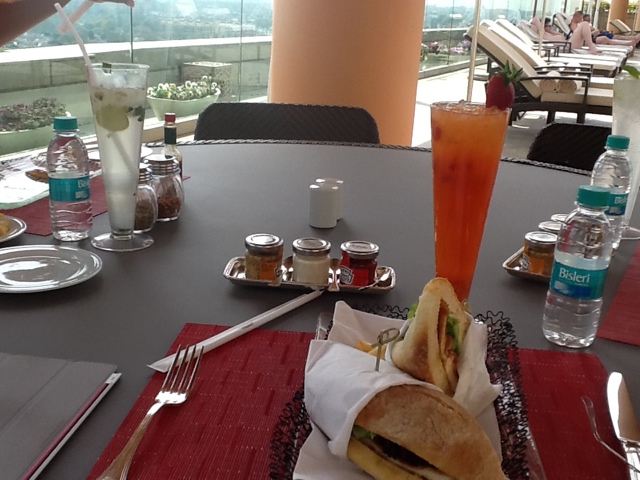
Just having breakfast.

This is the hotel we stayed at for one night before the train, so Sarah is happy with the choices.

Maybe it was a mistake going from this place straight to the train cabin. It was never going to stack up.

But I blame Sarah. She has been bleating on for months about how this train is on a par with the Orient Express. Having seen all of the Agatha Christie movies, I knew how retentive Hercule Poirot was. If he was happy with the detailing on the Orient, then we would be happy with the Maharaja. That was the theory, and nothing ever stacks up to theory.

But let's not be ungrateful. It's great to be back in a bed that doesn't try to rock you to sleep, although it may take a few days for our bodies to stop moving.


Sunday, March 10, 2013

New Delhi

We are now parked on the roof of the Leela Palace hotel, at poolside. Nice breeze up here.
Both ladies had a snooze this morning, but they are awake now.

The hotel driver was waiting for us when we got off the train after breakfast. Five minutes later and we were pulling up the drive of the hotel. Luckily, we were able to get our rooms straight away.

While Sarah slept, I uploaded the blogs I had been writing for the last week. I will continue to edit them and add photos as I go.


End of the line

We made it back to Delhi in one piece. Sarah slept quite well, because the train got in early and parked. No shaking.

Did I enjoy the trip? Hell yes!

Were the rooms on the train a little tatty? Sure. Did it matter? Actually, no.

Was the service onboard good? It was excellent.

Were the bus tours good? They were great.

Were the restaurants for lunch and dinner good? Brilliant.

Would I advise others to do this train trip? Absolutely.

Would I do it again myself? Actually, yes I would.

Is there anything I would recommend they improve? Sure. The rooms need freshening up, and some of the power sockets were a little dodgy, but that's just first impressions.

Would I recommend any preparation before the journey? Absolutely. Make sure you can sleep on a train. This is surprisingly important. Most people took a couple of days before they got much sleep. And then there was Sarah. She told everybody that she would not get a good sleep until the last night. Apparently, she is never wrong.
Also, a minimum level of fitness is kinda essential. There is a fair bit of walking to get the most out of it. And as I said, the steps can be a little intense for a minute or two.

I'm not talking athlete fitness. A fat slug like me is fine, but it was a little much for Sarah's mum by the end. We have only recently convinced her to ask for a wheelchair in airports, because of the long distances. She always used to trot alongside Bishu's wheelchair, loaded up with more hand luggage than Sarah would ever want to see on her watch.

Shopping

We were taken to a marble store on the way back to the train.

These are one of the families employed to do repairs on the Taj. We watch a demonstration of the style of inlay work done. They chisel a recess in the marble, and then glue carved pieces of semiprecious stones into place to make detailed patterns. The particular glue used to keep these stones from falling out after 400 years, is a family secret, handed down from father to son.


Sarah is tempted to get a benchtop made out of this stuff for our kitchen. So hard, it won't scratch. Watch this space, if I start doing overtime, then she may have started doing the maths.

And of course, Sarah did some shopping in another department. Clothes, of course! Taking one for the team.


Day Six

Sarah may have mastered being able to eat her meals during a never ending earthquake. She even managed to take a shower this morning on a particularly bumpy piece of track. But sleep? Not so much.
Even getting dressed, while occasionally challenging, is eventually achievable.
Left leg first. Come on you can do this, just lift that leg. You've been able to stand on one leg all of your life. A little movement isnt going to stop you. Just pick up your foot and punch it into that trouser leg. Here we go... Crash. Oh crap, feels like we ran over a cow. Lets try again.
This could go on for some time, until you throw in the towel and lie on your back and do an impression of an upside down turtle, with your legs wriggling around in the air. I think this is the approved method that fat girls use to try on stretch jeans in the mall.
You have to wonder. Did the fat girls learn it from the break dancers, or were they the inspiration?

Sarah says she had no sleep at all. This last stretch of track has certainly been challenging in parts.

Sarah's mum has decided to cut her losses and stay on the train today. She is surprisingly good with walking, but steps knock her for a six. And boy, do these forts and palaces have steps! Sarah says that some of them are up to her mums knees. Talk about a cardio workout. Maybe that was invented here.

We are heading for Agra. Oh dear, just saw my first squatter for the morning. I don't think I will have the blinds up during breakfast.

Agra is the location of a rather famous building. It is the shrine to all husbands who spend far too much on their wives. Sometimes I feel like I deserve a wing here myself!

There's a famous photograph of Princess Di sitting in front of this place. A couple of people back home have suggested that I should get a photo in the same location. But I don't look anything like Princy Di. Oh well. I just hope I don't obliterate the view of the building. I'm still the fat white guy, remember.

I'm sorry to disappoint those in the sweepstake that guessed I would lose half of my body weight, but I don't think I've lost anything. You can blame Sarah for that. She has managed to keep me away from everything so far. Bottled water seems to be the answer.

In the morning, we visit Agra Fort, or the Red Fort. These palaces and forts have so many courtyards. Very much a his and hers theme to the layout of these places.
Then lunch, and off to the big one.


Visiting the Taj Mahal is where you can see the advantage of being on this kind of tour. All the way along the trip, we have missed queues and gone straight in. But here. There is a queue that wraps around the base of the Taj before they can get to the steps. We go straight up. Then, up on the main platform, there is another queue that wraps around the building before they can get in. We go straight in.

To be honest, there isn't a hell of a lot to see inside. You walk around a bit, see a central chamber, and go out the back entrance to see the view over the river.

But the outside?
I'm sorry but I have to say it.
FUCK!
This building is fucking awesome!
The sheer majesty of it makes all civilized words pale into insignificance.
Somebody once described it as a teardrop on the cheek of time.
The marble it's built from is the hardest in the world. It is completely non-porous, and doesn't absorb any crap from the environment. Any dust or pollution gets washed off by the rain. It stays the original colour. Forever.


Not surprisingly, there is a bit of an industry around the Princy Di photo. There are photographers here, hawking their wares, all offering to photograph you on Princy Di's bench. Some of our group did it. They will not be best pleased that they got it wrong. Seriously! They got the wrong bench!

Look at the Princy Di photo. She is on an elevated platform with a pool at her feet, and the big white building behind her.
Now, google her bench, and you will get a million hits on people striking the pose. But they all have the pool behind them. Between them and the Taj.
Don't know why. The photographers just keep getting it wrong.
You'll see in my photo, I'm on the right bench. Can you see me? Sarah took it from the other side of the pool, where all the morons were lining up to sit for the birdie.
You will also see why I don't ask her to take many photos.


I've added a photo from the net to demonstrate. The bench that the dufus from Hollywood is standing on is in front of the pool. The photo of Di that he is comparing himself to, clearly has the bench between the pool and the Taj. He even had the original photo and he STILL fucked it up!!!


Indians all around the world should be proud of two things. First, that somebody in their heritage had the artistic genius to come up with something as beautiful as this thing. The fine, closeup detail as well as the broad strokes, the big picture.
Second, that the people are looking after it so well. There is tight security. Nothing is allowed in that can cause damage or litter. Almost all previous palaces, forts, temples and monuments were once buried in semiprecious detailing. In almost every case, everything worth anything was either stolen or fell off. Or both. Not here. It is in its original condition. We even have to wear little surgical booties over our shoes to walk on the marble. Impressive.


The locals didn't get to use the booties, they have to leave their shoes on a rack. With about 20,000 visitors here per day, good luck with that. "No, mine was the white runners. Yes there were two! The white ones. Nike. No, one Adidas won't do! Yes, size 9. Oh, just give me those jandals."


I have added some other shots, to show the beauty of the place. You know the designers who make a room neutral, so that a splash of colour lifts it? Well see what a few splashes of colour does for the big white tomb.



The Ganges River

You know the joke about where do Hindus go to die? No, nor do I, but this is the place.

For every Hindu, the goal is to visit this place once in their lives, bathe in it, and drink a little of the water. Given its record pollution over the years, drinking the water should ensure you're going to die here too.

The river is an unusual sight. It is one border of the city of Varanasi, the important one. Lots of activity on the bank. Here they call the bank a ghat, and it is separated into 84 ghats along the accessible length of the river. Im not sure how long each ghat is, but it can't be more than a few buildings long. There are houses, hotels, places of business.
As we drove to the river, our guide pointed out some cowpats covering the face of a wall to dry.
Just like the ones we had seen out in the country, these were the apartment living version, making use of available space. Quite clever, really.
He went on to tell us that a group of Japanese tourists, when shown the same wall, asked "how do the cows manage to do such perfectly round pats, and on the wall?" Mmmm!

After we left the bus, we were swarmed. Other than the normal tourist kitsch, many of these kids were trying to sell us candles, to float in the river later in the evening.
Sarah said something to them in Jibberachy, and they backed off from her. But that just made it worse for me. This one particular little girl seems to be trying to get between Sarah and me. You know how the big cats in Africa try to separate the weak animal from the herd? The sickly pale wildebeest, that's me. Easy prey, apparently.

We make our way precariously onto a boat ready for our journey along one of the worlds most historic rivers.
As we go along, it is a hive of industry. I can see level after level of windows climbing up the bank. Some of the bigger buildings are perhaps eight stories. Others are stacked behind each other, to achieve the same height. Building after building, as far as the eye could see, all the way down the riverbank. There are some very old buildings. Ancient, probably.


We pass one temple that may want to sue the local council. Or whoever built their foundation!!


We head downstream, towards streams of billowing smoke. You guessed it, skippy. Funeral pyres. Quite a few. All at the same ghat. A family business, this is the most famous Hindu cremation location in the world. Together with another one down the river, they are the only Hindu crematoriums allowed to operate 24/7, up to ten at a time. A real production line.

For obvious reasons, no photography is allowed in the vicinity, so as we approach, we are advised to put our cameras away. As the boats gather, our staff get a bit terse with tourists on other boats who continued clicking away. One woman responded, "If you can't take photos, then why is it so public?" I didn't hear the response, but I can't imagine it was particularly magnanimous.

We then moved onto another area, where a huge crowd was gathering. There is a prayer called Arti, which is held every night an hour after sunset. It seems to have become a tourist attraction, so there are still lots of children hovering about, selling floral candles for floating in the river after this prayer. One young girl who was walking from boat to boat, stopped on ours. A woman in our group asked the guide if the girl goes to school. In perfect English, the girl replies "I go to school". Priceless.
We were planing to leave before the service was over. With the number of boats that had pulled in behind us, not so much.

One thing we commented on, as we returned down the river in the dark. I have described the stacked buildings all down the city side of the river, but haven't mentioned the buildings on the other side. That's because there weren't any. At all.
Barren riverbank.

Apparently, if you live and die within the city confines, you will break the cycle of reincarnation. You will achieve nirvana, and become one with god. Outside the city, not so much.

They should sell the land to the Christians. They won't give a toss.
Here's a thought. Build hotels there. Imagine the value of having Hilton, Sheraton, Venetian, Wynn, Trump, all lined up on the far bank of the Ganges. I can't believe nobody has done it yet.


I'm just thinking about the gondoliers from the Venetian taking people out onto the river. There's a joke in there somewhere, but I think it best to step away from it.


Varanasi

A much more hectic city than I had expected from the religious centre of India. Very Bangladesh, especially the traffic.
Our guide today told us that there is only one rule with Indian traffic; whatever side of the road you're on, is the right side. He also said the reason it is the religious capital, is that if you experience the traffic here, you will be compelled to believe in god.

A previous guide told us that three things are required to survive on Indian roads; good brakes, good horn, and good luck.

How true those statements are.

On our way to our first event for the day, the bus dropped Sarah and her mum at the hotel we will be coming back to for lunch. Her dad comes from Varanasi, and she has relatives who wanted to meet up when we came into town.
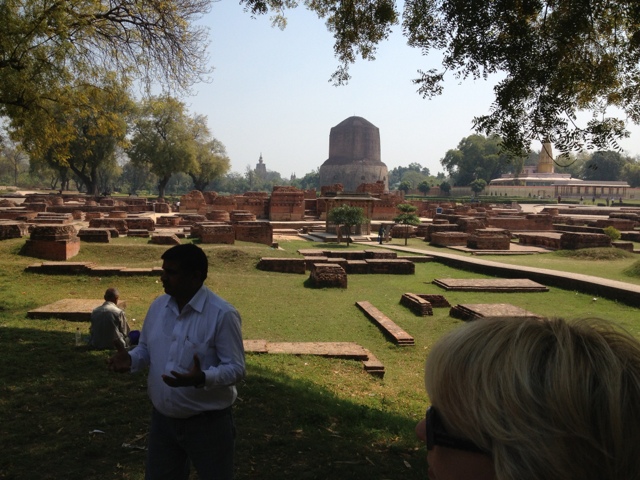
The rest of us went off to a Buddhist shrine. More of a ruin really, it's the location where Buddha made his first sermon. About 600 years BC. Buddhism is an offshoot of the Hindu religion, but without all the idolatry.


I find it intriguing that people have this compulsion to stick gold foil to things. Part of their process, I guess. Anyway, the signs clearly don't deter them. Real gold leaf, by the way. Or so I'm told. It wouldn't surprise me, actually. Despite the poverty, they still have a thing for real gold, 22 carat, no less. That's why the jewellery you will see on Indian women is much yellower-looking (is that a word) than what we are used to seeing. We tend to use 18 carat, because it's stronger. Anything less than 22 carat they tend to regard as costume jewellery. Go Figure.

The thing I was most impressed by, is a giant statue of Buddha, virtually next door to this site. It was built between 2001 and 2011 by the Thai Buddhist movement, as a response to the Taliban destroying the previously largest statue of Buddha, in Afghanistan.
As one of the others in my group said, that's the perfect non-violent response.
"Fuck you then, we'll just build another one, where you can't get to it." Excellent!!

Interesting that Varanasi is a pivotal location for both the Hindu and Buddhist religions. Not always. Many centuries ago, some ruler decided to ban all Buddhists from India. The religion, which started here, was now dead. Except that it had already spread to Thailand, where it has continued to thrive. It was only when this ruin was discovered a couple of centuries ago that Buddhism was allowed to take off again.


Something else I learned about the Hindu caste system. It isn't. Or at least it wasn't. Originally, the caste labels were intended as a description of somebody's career or skill. Kind of like our white collar and blue collar workers. If somebody studied hard, they could move from the streets to a much higher position. Just like in our society, anybody can move from a working class background to something better through hard work.
Obviously, if you are born into a particular class, it will be easier for you to succeed there. Again, no different from western society.
What happened here was that some born into the highest levels, the Brahmans and the warrior caste, wanted the benefits of their birth status without having to work for it. Through political pressure, the caste system moved from a skill category to birth category. Apparently, the writings of the Hindu faith make no mention of the caste system, because it simply didn't exist when they were written.

As we were about to leave in the bus, I saw something I have never noticed before. A sugarcane juice vendor. He has a cart, with what is effectively a wringer mounted sideways on it. As a small motor turns the wringer, he feeds a handful of sugarcane into the mouth of the machine. As he pulls the crushed stalks from the other end, juice pours back out of the mouth of the wringer, into a jug hanging underneath. He passes the cane through a few more times, until there is nothing but shredded pulp left. He then sells the juice to the public by the glass. He makes it to order, so the customer watches his drink being made.

Then back to that hotel for lunch. I meet Sarah's uncle, aunt, cousin and nieces. A lot of smiling and nodding, because they haven't found a need to learn English. So they leave, and Sarah's mum hops into a cab to go back to the train and rest. She didn't sleep last night, and is feeling crappy.

We then went to the temple of mother India. It's not really a temple, so I happily went inside. Other than a walkway around the outside wall, the whole building is a giant map of India on the floor. Not painted, but carved out of marble. A perfect scale topographical map.

A very impressive undertaking, built in the early 20th century, and consecrated by Gandhi. It's surprisingly fun to get a real-life perspective on an entire country. It includes every mountain in the Himalayas, plus surrounding islands. I haven't seen anything like it anywhere.


After that we went to a traditional silk weaving house, where they make saris, scarves, bedspreads. Other than the guy using a manual machine, I was very impressed to see them using what is regarded as the worlds first computer. A loom like the manual one, but it runs off a series of punch cards, linked together into either a continuous chain, or a very long sequence. Each punchcard tells the machine which bobbins to use, creating the pattern for a single line. So they can create a pattern that repeats every twenty lines, or one that has five hundred distinct lines of code.
The first computer. The first computer program. Double cool.

Then it was off to the Ganges river. Into a boat, and off we go, putt-putting our way into the most revered location in the Hindu world.

The right hand DEFINITELY knows what the left hand has been up to

Sarah is traumatized.

She has seen more than a dozen squatters this morning alone. This is not the brand of squatter that the poms will be familiar with. Tenancy issues. No. These are the guys squatting next to the path beside the railroad tracks, taking a dump. Crapping. Shitting. Laying a cable. In full view of anybody walking past, or any train.

She can't get over how brazen they are. Not only is it within OUR view, but that of their friends and neighbours as well. She saw about five of them, all squatting in a circle at once. I wonder what they talk about at these times. If nothing else, by seeing where their mates are, they at least know where not to step as they leave.
Yesterday, one of the people at breakfast asked if we'd seen the wall a few miles back. There was a row of brown bums cantilevered over the wall, all facing the train.

You may have heard the phrase "the left hand doesn't know what the right hand is doing." In our culture, it refers to communication issues between different arms of the same company.

In this country, the left hand / right hand distinction is quite literal. Right hand for eating, left hand for wiping your arse. You will often see people from Asia never use their left hand at the table. Maybe that's why they tend to eat with their hands, because only one is regarded as clean enough. Knife and fork must be a challenge with only the right hand.
Maybe that's why someone invented the chopsticks.
Actually, here's a thought. Make chopsticks hollow like straws. That way when the lumps are gone, you can hoover up the soup as well.

Heading For Varanasi

The brick factories I mentioned in Bangladesh are becoming a common sight here. I've seen a few this morning. A lot of brick construction, too.


As you can imagine, nothing much goes to waste here. We have passed many stacks of cowpats, drying in the sun. I think they mix them with straw, and mold them into shape. They use them for cooking. No, they don't go into the curry, they go under it. It is a source of fuel, for burning.


I'm not sure, but the briquettes they're making look remarkably like the tiles on the roofs of the huts we are passing. I'm told that dung is a good form of insulation, so maybe. Many huts will actually have dung spread out on the floor, and polished. When dry, it is quite hard, especially when polished. Quite a sheen, I'm told.
But as roof tiles? I don't imagine they would survive long in the monsoons. They would dissolve fairly quickly in water. So, if you are staying in a village hut in India, I suggest you don't sleep on your back during the monsoon. You may end up tasting the roof. Nice.


Day Five

We appear to be climbing. The first thing I see when I raise the blind is white sails. Sailboats. Oh. The sea, cool.

Then I remember that we are nowhere near the sea. Those white sails in the distance must have been more temples.

Much more vegetation here. Just went past a factory called The Indian Hume Pipe Co. Didn't realize Hume's were here. They have a branch in Christchurch.

Sarah still isn't sleeping well. The curse of being a light sleeper. Actually, she commented a few days ago that the movement of the train is similar to how the earthquakes felt. I agree. I was just lying here when the train started again. (They stop and start a lot.) As we got moving, I had a strong memory of being in Christchurch.


We pass a lot of wells. Obviously a lot of water in this region.
I imagine there are three types of well. The romantic ones from the children's stories, with a little roof and a bucket on a rope. Then there is the realistic one. Just a pipe coming out of the ground, no other visible sign.
And then there are the wells in India. They don't have the little wall like the first kind, and they are not covered like the second. It is a large hole in the ground, with brick sides, but flush with the ground. Imagine walking along at night (no street lights out here), and then suddenly PLOP! I wonder how many animals and small children disappear into these on a daily basis.


We stop at the village of Khajuraho. There is nothing here to speak of, except for temples. We see a few in one area before lunch, and the main ones after lunch.

By the way, this is the area where a little book called the Karma Sutra was written, in about 300AD. These temples were built about 700 years later, and the carvings on them, like all similar temples, depict all parts of life. These local ones, however, seem to have taken a lot of inspiration from said book. And our guide seems to take an inordinate interest in that aspect of the artwork. His dialogue certainly is geared towards the 12 year old boy. Ben, you may want to add this tour to your bucket list.
"Do you see what he is doing? Do you see where her hand is? Do you know what that position is called?" They've got it all covered. Twosomes, threesomes, foursomes, goatsomes, donkeysomes. Upside down, inside out. Somersault with a double twist. Skinny latte with a double shot.
A little much for the age group, really. I now call these the Porn Temples.
Want details? Google "temple art Khajuraho" for more explicit pictures. I recommend you don't google "porn temple". I shudder to think what that will find. That's only my name for the place.

I was going to buy a set of key rings for Ben from one of the hawkers at the bus door. You know the type. Two little metal figures that "interact" when you shake it. The war office vetoed that idea. Sorry, Ben 10.

That reminds me. One of our party responded to a hawker in French (I think). Rather than put him off, he started forth in a full blown conversation in what appeared to be pretty good French.
I forget that they must have tourists from everywhere coming here on a daily basis.
So easy to underestimate these people.
They probably have more languages than Sarah. Me? Like most white folks, I struggle with just the one, thanks.
By the way, for the average Australian, English is their second language. They don't have a first.

We finished the evening with a culture show, some young people doing traditional dancing. Very colourful.